

I. What Is a Wire Mesh Cable Tray?
A Modern Solution for Open Cable Management Systems
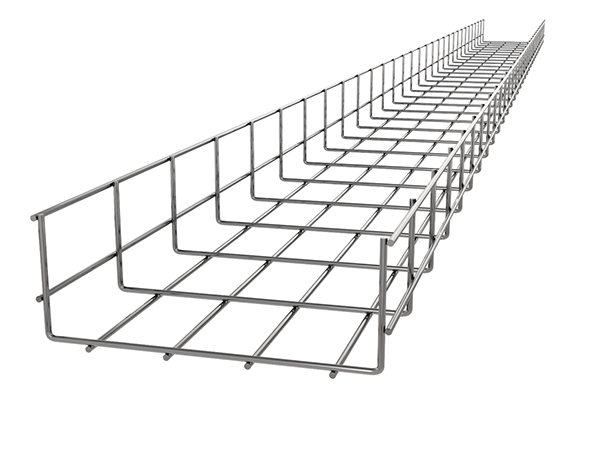
A Wire Mesh Cable Tray is a revolutionary cable support system made of high-strength steel wires welded into a mesh structure. It is specifically designed for modern high-density cabling environments.
Compared with traditional enclosed cable trays, its open architecture provides superior heat dissipation, flexibility, and maintainability. It has become the preferred cabling solution for data centers, intelligent buildings, and industrial facilities.
II. Six Core Advantages of Wire Mesh Cable Trays: Why Professional Engineers Prefer Them
1. Superior Heat Dissipation Performance
The open mesh structure ensures free air circulation around cables, effectively reducing operating temperature by 15–25% and extending cable service life by more than 30%. This makes it especially suitable for high-load data center environments.
2. Flexible and Scalable Design
·Modular components: Standard-size sections can be quickly connected to adapt to complex building structures
·On-site adjustability: Can be cut and bent without specialized tools, supporting future expansion
·Multi-directional routing: Supports horizontal, vertical, and inclined installations
3. Excellent Load-Bearing Capacity
Manufactured using high-quality Q235 steel or stainless steel and reinforced through welding processes, the load capacity can exceed 150 kg/m per unit length, while remaining 40–60% lighter than traditional cable trays.
4. Optimized Lifecycle Cost
·Installation speed increased by 50%, reducing labor costs
·No need to dismantle entire sections during maintenance, reducing troubleshooting time by 70%
·Reusability rate up to 90%, supporting multiple relocations
5. Visualized and Intelligent Management
The open structure supports:
·Real-time cable status inspection
·Fast fault location
·Integration with color labeling systems
·Future integration with intelligent monitoring devices
6. Excellent Environmental Adaptability
Surface treatments such as hot-dip galvanizing, electro-galvanizing, or powder coating provide corrosion protection up to C4 level or above, suitable for extreme temperatures ranging from -40°C to 120°C.
III. Professional Purchasing Guide: 5 Steps to Choose the Most Suitable Wire Mesh Cable Tray
Step 1: Define the Application Scenario
|
Application Scenario |
Recommended Specification |
Special Requirements |
|
Data Center / Server Room |
Width 300–600mm, galvanized |
Fire-resistant coating, grounding continuity test |
|
Industrial Plant / Production Line |
Width 200–400mm, reinforced type |
Corrosion resistance, seismic design |
|
Commercial Office Building |
Width 100–300mm, aesthetic type |
White powder coating, concealed installation |
|
Infrastructure Projects |
Custom width, high strength |
Outdoor protection rating above IP54 |
Step 2: Calculate Load Parameters
·Total cable weight calculation: cable density × length × safety factor (recommended 1.5)
·Tray span selection: choose standard spans of 1.5m / 3m / 4.5m according to load
·Side height matching: 50mm / 75mm / 100mm based on capacity requirements
Step 3: Material and Surface Treatment Selection
·Low carbon steel + hot-dip galvanizing: Best cost-performance ratio, suitable for indoor dry environments
·Stainless steel 304/316: High-corrosion environments, food and chemical industries
·Aluminum alloy: Lightweight requirements, electromagnetically sensitive environments
Step 4: Check the Completeness of the Accessory System
Ensure the supplier provides:
·Full range of connectors (tees, crosses, elbows)
·Multiple suspension solutions (hanging rods, wall brackets)
·Grounding system components
·Dedicated installation tool kits
Step 5: Certification and Compliance
Must comply with:
·National standard: GB/T 21762-2008
·International standards: IEC 61537, UL 1569
·Industry certifications: CE, RoHS, ISO9001 Quality Management System

IV. Comprehensive Comparison: Wire Mesh Cable Tray vs Traditional Systems
|
Feature Dimension |
Wire Mesh Cable Tray |
Ladder Cable Tray |
Trough Cable Tray |
|
Heat Dissipation |
★★★★★ |
★★★☆☆ |
★★☆☆☆ |
|
Installation Flexibility |
★★★★★ |
★★★☆☆ |
★★☆☆☆ |
|
Initial Cost |
★★★☆☆ |
★★★★☆ |
★★★★★ |
|
Maintenance Convenience |
★★★★★ |
★★★☆☆ |
★☆☆☆☆ |
|
Aesthetic Appearance |
★★★★☆ |
★★★☆☆ |
★★★★★ |
|
Typical Applications |
Data Centers / Industrial |
Power Main Lines |
Commercial Buildings |
V. Industry Trends and Future Outlook
Intelligent Upgrades
·Integrated monitoring systems: built-in temperature, humidity, and vibration sensors
·Digital twin management: each physical tray corresponds to a digital model
·AI predictive maintenance: data-driven fault prediction
Green and Sustainable Development
·Material recycling rate increased to 95%
·Modular design supporting circular economy principles
·30% reduction in energy consumption through cooling synergy effects